
Choosing the right LED Downlight Manufacturer is an important decision for lighting wholesalers, importers, distributors, contractors, and commercial project buyers. A reliable manufacturing partner can help businesses source suitable lighting products, maintain consistent specifications, manage purchasing costs, and build a stable supply chain. However, selecting a supplier based only on price may lead to problems with product suitability, quality consistency, delivery planning, and after-sales communication.
LED downlights are widely used in homes, offices, hotels, retail stores, and commercial buildings. Although many products have a similar appearance, their optical performance, installation methods, construction, and available configurations can differ. For B2B buyers, working with an experienced LED Downlight Manufacturer means evaluating more than the product itself. It also means reviewing manufacturing capabilities, technical support, order flexibility, and the supplier’s ability to support long-term business growth.
This guide explains how to evaluate an LED downlight supplier, compare product specifications, prepare wholesale orders, and identify a suitable manufacturing partner. It also introduces how buyers can explore OKES lighting products and discuss their sourcing requirements.
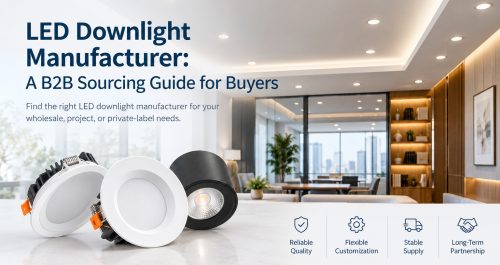
Why Choose an Experienced LED Downlight Manufacturer?
An experienced LED Downlight Manufacturer can help buyers understand available product options, clarify technical requirements, and identify suitable solutions for different lighting applications. For businesses purchasing in bulk, these factors can influence customer satisfaction, inventory management, and project performance.
Product Variety from an LED Downlight Manufacturer
Different applications require different lighting solutions. Residential customers may prioritize visual comfort and an attractive ceiling appearance, while retail stores may need carefully directed light to highlight merchandise. Hotels, offices, and commercial developments may require consistent lighting across multiple rooms or locations.
A suitable manufacturer should help buyers compare relevant product categories, such as recessed downlights, surface-mounted downlights, and adjustable designs, where available. Buyers should explain the intended application, installation method, desired appearance, and lighting requirements before requesting recommendations.
For distributors, a product range that serves different customer segments can create opportunities to expand their catalog. For project contractors, selecting products that match the lighting design can simplify procurement and reduce the risk of specification changes.
Explore the OKES product range to review available lighting categories and identify suitable products for further evaluation.
Manufacturing Capability and Quality Management
When evaluating an LED Downlight Manufacturer, buyers should look beyond factory size or promotional claims. The more important questions concern production management, specification control, inspection procedures, and the ability to fulfill repeat orders consistently.
Ask how the supplier manages product specifications, incoming materials, production processes, finished-product inspection, and packaging. If your business requires a particular specification, confirm how the manufacturer identifies and maintains that specification across future orders.
Documentation is also important. Request relevant technical information for the exact model under consideration and verify whether the available documents meet your market and project requirements. Do not assume that documentation for one product automatically applies to another.
You can learn more about the company through the OKES official website’s company introduction.
How to Select the Right LED Downlight Manufacturer for Your Project
The best manufacturing partner is one that can supply products suited to your application and commercial requirements. Before comparing quotations, define the essential product specifications and identify which requirements are mandatory and which are flexible.
Compare Wattage, Lumen Output, and Beam Angle
Wattage measures electrical power consumption, while lumen output indicates the quantity of visible light emitted. These values describe different characteristics, so buyers should not use wattage alone to judge lighting performance.
When comparing proposals from an LED Downlight Manufacturer, request the relevant technical specifications for each model. Review lumen output alongside power consumption, and consider the beam angle to understand how light is distributed.
A narrow beam may be suitable for accent lighting, whereas a wider distribution may work better for general illumination. The final selection also depends on ceiling height, room dimensions, fixture spacing, surface finishes, and the desired visual effect.
For larger projects, a lighting layout or simulation can help verify whether the proposed products meet the design objectives. Buyers should compare equivalent specifications rather than assuming that products with similar wattage will deliver the same results.
Evaluate Color Temperature and Color Rendering
Color temperature influences the atmosphere of an interior. Warmer light is often considered for residential and hospitality environments, while neutral white light may be preferred in offices and many commercial spaces. The best choice depends on the design brief, local preferences, and the intended use of the room.
Color rendering is particularly relevant in retail stores, hotels, and spaces where the appearance of products, materials, and finishes matters. Ask your LED Downlight Manufacturer to provide the available specifications for color temperature and color rendering for the selected model.
Consistency is also important for repeat purchases. If you are supplying a chain of stores or managing a multi-stage project, confirm the required specifications before ordering and keep an approved record for future procurement.
Confirm Installation and Environmental Requirements
Before selecting a product, confirm whether the application requires recessed or surface-mounted installation. For recessed downlights, check the ceiling cutout, fixture dimensions, installation depth, and clearance requirements. For surface-mounted products, verify the mounting arrangement and available space.
Environmental conditions must also be considered. Locations exposed to moisture, dust, or other demanding conditions may require products with specific protection characteristics. Never assume that every downlight is suitable for bathrooms, outdoor areas, or specialized industrial environments.
If your project requires a particular ingress protection rating, dimming function, control compatibility, or electrical configuration, communicate these requirements before placing an order. Ask the LED Downlight Manufacturer to confirm the specifications of the exact model in writing.
What B2B Buyers Should Ask an LED Downlight Manufacturer Before Ordering
A clear procurement process helps buyers compare suppliers fairly and avoid misunderstandings. Before committing to a wholesale purchase, establish the product specification, order quantity, packaging requirements, commercial terms, and expected delivery schedule.
Request Samples and Technical Documentation
Where practical, request a sample before placing a large order. Samples allow your team to evaluate appearance, finish, dimensions, installation details, and other relevant product characteristics. They can also help project stakeholders confirm whether the product suits the lighting design.
Ask the manufacturer for a datasheet or other available technical documents covering the exact model. Check that the documentation corresponds to the proposed product and contains the information relevant to your application.
If the destination market requires particular testing documents, compliance evidence, or product labels, raise these requirements at the beginning of the sourcing process. Confirm availability for the specific product instead of assuming that every model has the same documentation.
Compare Wholesale Quotations Fairly
The lowest unit price does not necessarily represent the best purchasing value. Quotations may differ in specifications, packaging, minimum order quantities, customization, shipping terms, and included services.
To compare an LED Downlight Manufacturer with other potential suppliers, provide each company with the same product requirements and purchasing information. Include the intended application, requested quantity, packaging needs, destination market, customization scope, and target delivery schedule.
Consider the total procurement cost rather than the product price alone. Freight, import duties, inventory holding, product replacement, and after-sales handling can all affect the overall cost of ownership.
A standardized request for quotation makes it easier to identify meaningful price differences and avoid comparing products that are not technically equivalent.
Evaluate Lead Times and After-Sales Support
Reliable supply planning is essential for distributors managing inventory and contractors working to project deadlines. Ask suppliers to distinguish sample preparation, production lead time, and shipping time. Confirm whether the proposed schedule depends on material availability, customization, or approval procedures.
For repeat orders, discuss how changes to specifications, packaging, or production arrangements will be communicated. Establish a clear process for reporting quality concerns and resolving discrepancies between confirmed specifications and delivered goods.
A dependable LED Downlight Manufacturer should communicate commercial conditions clearly and explain the available process for handling product questions or potential quality issues. Keep the agreed terms in writing so both parties can refer to the same requirements throughout the order cycle.
Why Consider OKES as Your LED Downlight Manufacturer?
Selecting a supplier requires reviewing its products, company information, and available cooperation arrangements. OKES provides a lighting product portfolio that B2B buyers can evaluate when exploring potential sourcing partners.
Explore Lighting Products for Different Market Needs
Distributors, importers, and contractors may serve several customer segments, from residential lighting to commercial projects. Reviewing a manufacturer’s product portfolio can help buyers identify suitable categories and determine whether the available range aligns with their target market.
When evaluating OKES as your LED Downlight Manufacturer, begin by identifying the product types and specifications relevant to your business. Request current product information and confirm available configurations, packaging options, order conditions, and other details directly with the company.
This approach helps ensure that purchasing decisions are based on the requirements of your market rather than assumptions about the entire product category.
Discuss OEM and ODM Cooperation Requirements
Some businesses need products that support their own brand positioning. Depending on the manufacturer’s capabilities and the specific project, OEM or ODM cooperation may involve agreed branding, packaging, product presentation, or other customization requirements.
Before discussing a customized order, prepare a brief covering the target market, application, technical requirements, estimated quantity, branding needs, and launch schedule. Ask which elements can be customized and what minimum order quantities, costs, sample approvals, and lead times apply.
These details should be confirmed for each project. A clearly defined scope helps both parties assess feasibility before investing time and resources.
For additional background on supplier cooperation, review the OKES OEM LED lighting article.
Build a Long-Term Supplier Relationship
Long-term cooperation depends on more than the initial quotation. Clear communication, accurate documentation, specification control, and predictable order coordination all contribute to a more efficient sourcing relationship.
When assessing OKES or another potential supplier, consider how clearly product questions are answered, whether quotations contain sufficient detail, and how changes are managed. These practical factors are particularly important for businesses that expect recurring orders or need to coordinate several projects.
Use the company’s official information and direct discussions with its team to assess whether its capabilities match your purchasing requirements. Confirm all model-specific details, delivery arrangements, and commercial terms before proceeding with an order.
Common Mistakes When Choosing an LED Downlight Manufacturer
Even experienced buyers can encounter sourcing problems when requirements are incomplete or suppliers are compared inconsistently. Avoid these common mistakes to improve purchasing decisions.
- Choosing based on price alone: Compare product specifications, packaging, logistics, and support services alongside unit cost.
- Ignoring technical performance: Review lumen output, beam angle, color characteristics, and application suitability instead of relying only on wattage.
- Overlooking installation conditions: Confirm fixture dimensions, ceiling compatibility, electrical requirements, and environmental suitability.
- Assuming all products have the same compliance status: Request documentation relevant to the exact model and destination market.
- Leaving customization until the last minute: Agree on branding, packaging, artwork approval, and other requirements before production begins.
- Failing to document the final agreement: Keep the approved specifications, quotation, sample confirmation, order quantity, and delivery terms in writing.
A structured evaluation process helps buyers select an LED Downlight Manufacturer based on business needs rather than a single selling point. It can also make repeat orders easier to manage and reduce avoidable communication problems.
Conclusion: Choose the Right LED Downlight Manufacturer for B2B Growth
Finding the right LED Downlight Manufacturer requires a balanced assessment of product suitability, technical documentation, quality management, production planning, customization options, and after-sales communication. A competitive price matters, but it should be considered alongside the requirements of your customers and the total cost of procurement.
Start with a clear product specification, compare equivalent quotations, and request samples when appropriate. Confirm installation conditions, verify relevant documentation, and make sure the final order records accurately describe the products being purchased. These steps can reduce sourcing uncertainty and support a more dependable supply strategy.
OKES offers a lighting product portfolio and company information that B2B buyers can review as part of their supplier evaluation. Whether you are sourcing downlights for wholesale distribution, commercial projects, or a private-label program, contact OKES to discuss your requirements, explore suitable product options, and request a quotation.
Visit the OKES Contact Us page to discuss your next lighting order.
FAQ: LED Downlight Manufacturer
1. How do I choose a reliable LED Downlight Manufacturer?
Evaluate product suitability, quality management, technical documentation, communication, delivery planning, and after-sales support. Request samples where practical and confirm that the proposed model meets your requirements before placing a bulk order.
2. What should B2B buyers compare when sourcing LED downlights?
Compare the exact model, wattage, lumen output, beam angle, color temperature, color rendering, installation dimensions, packaging, order quantity, lead time, and commercial terms. Use consistent requirements when requesting quotations from different suppliers.
3. Is the lowest-priced LED downlight always the best option?
No. A lower unit price may come with differences in specifications, packaging, logistics, or service arrangements. Consider total procurement costs and product suitability rather than relying on price alone.
4. What information should I provide when contacting an LED Downlight Manufacturer?
Provide the intended application, required product type, technical specifications, estimated quantity, destination market, packaging requirements, customization needs, and target delivery schedule. Include any project-specific documentation or compliance requirements.
5. Can an LED Downlight Manufacturer provide OEM or ODM services?
Some manufacturers support OEM or ODM cooperation, but the available services depend on the supplier and product. Confirm the customization scope, minimum order quantity, costs, sample approval process, and production lead time before placing an order.
6. Why should I request samples before placing a wholesale order?
Samples allow buyers to evaluate appearance, finish, dimensions, installation details, and other relevant characteristics before committing to a larger quantity. They can also serve as a reference when confirming product specifications.
7. How can I contact OKES about LED downlight sourcing?
Visit the OKES Contact Us page to discuss your purchasing requirements, ask about suitable lighting products, and request information for wholesale or project-based orders.