
Choosing the right LED lighting supplier is an important decision for lighting engineering companies, architectural lighting contractors, importers, wholesalers, retail lighting distributors, and smart building integrators. The right supplier should offer suitable lighting products, clear technical documentation, consistent quality, dependable supply, and responsive after-sales support.
For professional buyers, selecting an LED lighting supplier involves more than comparing unit prices. Energy efficiency, expected service life, product compliance, warranty terms, dimming compatibility, and customization options can all influence the total cost and success of a lighting project.
A supplier that understands these requirements can help buyers coordinate product selection, reduce purchasing risks, and serve their customers more effectively. This guide explains how to evaluate an LED lighting supplier, what to confirm before placing an order, and how to build a practical sourcing process for commercial lighting projects and distribution businesses.
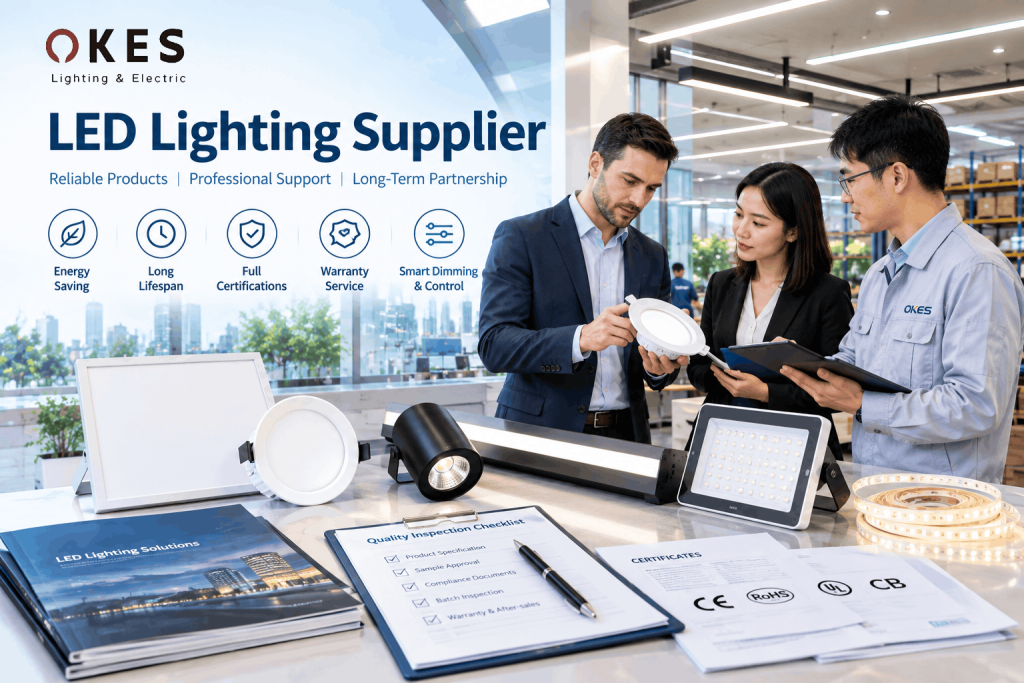
What Should a Professional LED Lighting Supplier Provide?
A professional LED lighting supplier should help buyers identify suitable products and confirm whether those products meet the requirements of their applications and markets. The exact services available will vary by supplier, product category, and order arrangement.
A Suitable Range of LED Lighting Products
Different projects require different lighting fixtures. Offices may need panel lights and downlights, while retail stores and showrooms may require track lights and spotlights. Outdoor and landscape projects may involve floodlights, garden lights, wall lights, or street lighting products.
Working with an LED lighting supplier that offers several relevant product categories can simplify sourcing and help buyers coordinate specifications across a project. However, a broad catalogue does not automatically mean that every product is suitable for every application.
Buyers should confirm fixture dimensions, light output, color temperature, installation requirements, electrical specifications, and environmental suitability for each model.
Explore the OKES product collection to review its listed categories, including panel lights, downlights, spotlights, track lights, ceiling lights, strip lights, solar lighting, and outdoor fixtures.
Technical Information and Product Support
A dependable LED lighting supplier should be able to explain the available specifications and provide relevant documentation for the products being considered.
Depending on the model, buyers may need technical datasheets, installation instructions, product labels, test reports, and applicable compliance documents. For project procurement, this information helps engineers and contractors compare products against their lighting designs and purchasing specifications.
When a product description is unclear, ask for written confirmation instead of making assumptions. This is especially important when ordering large quantities or specifying fixtures for a project with strict technical requirements.
Supply and Cooperation Options
Importers, wholesalers, and distributors may need a consistent product range, suitable packaging, repeat-order support, and clear communication about lead times. Engineering contractors may prioritize project coordination, sample approval, and delivery arrangements.
Some buyers may also require private-label products or customized packaging. An LED lighting supplier offering OEM or ODM cooperation may be able to support these needs, depending on its capabilities and the agreed project scope.
Before choosing a cooperation model, clarify minimum order quantities, sample requirements, customization costs, production schedules, and approval procedures.
How to Evaluate an LED Lighting Supplier for Project Requirements
1. Match Product Selection to the Application
The first step is to define what the lighting needs to achieve. A retail shop may prioritize display lighting and adjustable beam direction, while an office may require uniform illumination and visual comfort. A landscape project may need fixtures suitable for outdoor exposure and specific installation conditions.
A project brief should identify the application, mounting method, lighting objectives, estimated quantities, and operating environment. This gives the LED lighting supplier a clearer basis for recommending relevant products.
Where necessary, ask the supplier or lighting designer to provide supporting technical information so that the proposed fixtures can be checked against the project specification.
2. Compare Energy Efficiency and Light Output
Energy efficiency is a major consideration for buyers managing operating costs. However, wattage alone does not show how effectively a fixture illuminates a space.
Compare rated power consumption with luminous output and consider the required illumination level, beam distribution, and lighting layout. A suitable lighting design can help avoid excessive fixture quantities or insufficient illumination.
For commercial and engineering projects, the evaluation may also include color temperature, color-rendering performance, glare control, and lighting uniformity.
Ask the LED lighting supplier for the specifications of the exact models being quoted. If energy consumption is a key purchasing criterion, compare products using consistent measurement information and application requirements rather than relying on broad marketing claims.
3. Consider Expected Service Life and Maintenance
Product lifespan affects long-term operating costs, especially in facilities where fixtures run for extended periods or are difficult to access.
LED performance depends on factors such as component quality, driver design, thermal management, operating temperature, and usage conditions. Buyers should review the stated lifespan and supporting technical information for each model.
It is also useful to consider maintenance access, spare-part availability, and the process for dealing with product failures. Replacing a fixture in a high-ceiling commercial space may require more labor and equipment than replacing one in an easily accessible room.
A suitable LED lighting supplier should help buyers understand the available product information and clarify the warranty and after-sales arrangements before an order is confirmed.
Certifications, Quality Control, and Product Compliance
Verify Model-Specific Compliance Documents
Certification and compliance requirements depend on the destination market, product category, electrical design, and intended application. Importers and distributors should identify the documents required before confirming a purchase.
Ask the LED lighting supplier for applicable certificates, declarations, test reports, labels, and other technical files. Check that the model numbers and document scope correspond to the products being ordered.
Do not assume that a certificate for one fixture automatically applies to every product in a catalogue. Likewise, a general company management certificate is not necessarily a substitute for product-specific compliance evidence.
OKES describes its company background and certification experience on the About OKES page. Buyers should confirm which documents are available for the selected models and whether they meet the requirements of the target market.
Ask About Quality Inspection
Quality inspection helps determine whether products match the agreed specifications. Depending on the order, checks may include appearance, dimensions, labeling, packaging, electrical function, and relevant lighting performance.
For larger purchases, buyers should consider approving a sample before production and documenting the acceptance criteria. The approved sample and written specifications can serve as a reference when reviewing the production batch.
Discuss how the supplier handles nonconforming products, inspection records, corrective actions, and shipment approval. Clear procedures can help reduce disagreements and make it easier to resolve issues before installation or resale.
Choosing an LED Lighting Supplier for Smart Controls and Integration
Smart lighting requirements are increasingly relevant to commercial buildings, hospitality projects, and integrated building systems. Buyers may need dimming, scheduled operation, scene settings, occupancy-based control, or coordination with third-party automation systems.
However, not every LED fixture supports every control method. Compatibility depends on the fixture, driver, dimmer, controller, communication protocol, and system design.
Before ordering, confirm:
- Whether the exact fixture supports the required dimming function.
- Which driver or control method is compatible with the model.
- Whether additional controllers, sensors, or gateways are required.
- Whether the proposed components have been tested together.
- What wiring, installation, and commissioning requirements apply.
- Whether the intended third-party system supports the required integration.
For weak-current contractors and smart building integrators, these checks should happen before the product list is finalized. Confirm technical details in writing and test representative components where appropriate.
A capable LED lighting supplier should provide accurate product information and clarify the functions available for the selected models. Do not assume that app control, wireless communication, or centralized management is included unless the product documentation explicitly confirms it.
Warranty and After-Sales Support from an LED Lighting Supplier
Product support is an important consideration for distributors and contractors who must respond to customer questions and operational issues.
Before purchasing, confirm the warranty period, covered components, exclusions, claim procedure, required evidence, and available repair or replacement arrangements. These terms may vary by product and order.
Buyers should also ask how technical questions are handled and whether installation guidance or product training is available for the selected range. Clear communication can make it easier to diagnose problems and determine the appropriate next step.
OKES provides information about product support and after-sales service in its FAQ section. Contact the company to confirm the conditions applicable to the specific products and purchase agreement.
For importers and wholesalers, after-sales arrangements should be considered alongside purchase price and delivery terms. A lower initial cost may not represent the best overall value if product issues create additional handling, replacement, or customer-service expenses.
Why Consider OKES as Your LED Lighting Supplier?
OKES states that it has operated in the lighting industry since 1993. Its official website presents a range of lighting categories and describes manufacturing, OEM/ODM cooperation, and international partner opportunities.
These capabilities may be relevant to lighting engineering companies, architectural lighting contractors, importers, wholesalers, retail distributors, and smart building integrators looking for lighting products across different applications.
When evaluating OKES for your project or distribution business, provide clear information about the products required, target market, estimated quantities, technical specifications, and delivery expectations.
For customized or private-label orders, confirm the available customization scope, minimum order quantity, sample approval process, packaging requirements, and production lead time. For projects requiring dimming or smart controls, specify the control method and ask for model-specific compatibility information.
The most appropriate supplier relationship depends on your purchasing model. A distributor may prioritize repeat-order consistency and product range, while an engineering contractor may focus on technical coordination, compliance documentation, and project delivery.
LED Lighting Supplier Checklist Before You Place an Order
Use this checklist when comparing quotations and preparing a purchase order:
- Product suitability: Confirm the fixture type, application, installation method, and required lighting performance.
- Technical specifications: Review power consumption, luminous output, color characteristics, dimensions, and electrical requirements.
- Energy and lifespan: Request relevant product information and confirm the operating conditions behind stated claims.
- Compliance: Verify the documents applicable to the exact model and destination market.
- Quality: Approve samples where appropriate and establish written acceptance criteria.
- Smart controls: Confirm dimming and system compatibility before finalizing the product list.
- Warranty: Review coverage, exclusions, claims procedures, and after-sales arrangements.
- Supply terms: Confirm quantities, packaging, lead times, delivery terms, and repeat-order expectations.
- Customization: Clarify OEM/ODM scope, sample approval, and any additional costs.
- Communication: Establish who will handle technical questions and quality issues.
A written checklist makes supplier comparisons more consistent and helps identify missing information before a purchase order is issued.
Conclusion
Choosing the right LED lighting supplier requires a balanced assessment of product suitability, energy efficiency, expected service life, quality control, compliance documentation, smart-control compatibility, and after-sales support.
For lighting contractors, importers, wholesalers, distributors, and system integrators, a clear purchasing process can reduce avoidable risks and support more reliable project delivery. Rather than comparing suppliers on price alone, buyers should verify product-specific information and agree on important technical and commercial conditions before ordering.
OKES offers a range of lighting products and describes its manufacturing and cooperation capabilities on its official website. By sharing your requirements and confirming the details of the selected models, you can assess whether its products and available services fit your project or distribution needs.
Looking for an LED lighting supplier for your next project or wholesale order? Visit the official OKES website to explore its product range and contact the team about specifications, samples, compliance documents, customization options, and after-sales support.
FAQ
1. What should I look for in an LED lighting supplier?
Review product suitability, technical documentation, quality control, applicable compliance documents, supply arrangements, warranty terms, and communication. The right priorities depend on whether you are purchasing for a project, wholesale distribution, or retail sales.
2. How can I verify an LED lighting supplier’s product quality?
Request technical datasheets and relevant test documentation, inspect samples, and establish written acceptance criteria. For larger orders, agree on an appropriate inspection process before shipment.
3. Why are certifications important when sourcing LED lighting?
Applicable compliance documents help buyers assess whether products meet relevant requirements in the destination market. Always verify the document scope and model identification instead of assuming that all products share the same certifications.
4. Can an LED lighting supplier support smart dimming?
Some products support dimming or other control functions, but compatibility varies by model and system. Confirm the driver, control method, additional equipment, and integration requirements before ordering.
5. What warranty information should buyers confirm?
Confirm the warranty period, covered components, exclusions, claim procedure, required evidence, and available repair or replacement arrangements. Do not assume that every product has identical warranty terms.
6. Does OKES offer OEM/ODM cooperation?
OKES describes OEM/ODM cooperation options on its official website. Contact the company to confirm available customization, minimum order quantities, sample approval, packaging, costs, and lead times for your specific requirements.
7. How can I request an LED lighting quotation from OKES?
Prepare your target product categories, estimated quantities, destination market, technical specifications, required compliance documents, and delivery expectations. Contact OKES through its official website to discuss suitable products and request information for your project or wholesale order.