
Dimmable LED lighting has become a baseline specification in commercial, hospitality, and infrastructure projects. For lighting engineering companies, importers, wholesalers, and smart building integrators, the question is no longer whether a fixture can dim—it is whether the entire lighting system delivers stable dimming performance, energy savings, and seamless integration with building control platforms across hundreds of control points.
OKES has manufactured lighting products since 1993 from its base in Zhongshan, China, building a vertically integrated production model that covers light source modules, drivers, and structural components . This guide examines what B2B buyers should prioritize when sourcing dimmable LED lighting, how smart control capabilities affect project outcomes, and where OKES positions itself as a manufacturing partner for dimming-capable installations.
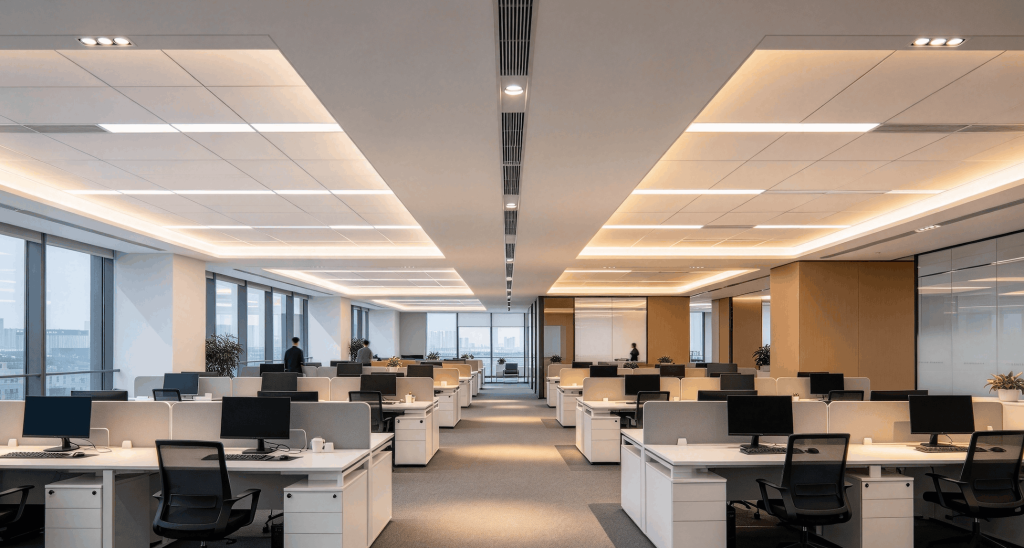
Why Dimmable LED Lighting Matters for Energy and Longevity
Energy Savings Beyond the Fixture
The energy case for LED lighting is well established. What dimmable LED lighting adds is the ability to match consumption to actual use. In commercial offices, dimming can reduce lighting energy use by 20–40% depending on occupancy patterns and daylight availability. For projects pursuing green building certification or meeting client sustainability targets, dimming capability is often written into the specification before fixture selection begins.
For importers and wholesalers, dimmable products open access to project-based sales channels that non-dimmable commodity fixtures cannot reach. A hotel renovation, a corporate headquarters fit-out, or a municipal lighting upgrade will almost always require dimming functionality.
Long Lifespan Through Thermal and Driver Quality
Dimmable LED systems, when properly matched with compatible drivers, operate at lower junction temperatures during dimmed hours. This directly extends the useful life of the LED module and reduces lumen depreciation over time. For facility managers and lighting contractors responsible for maintenance contracts, the difference between a well-designed dimming system and a poorly matched one has real cost implications.
OKES’s product listings specify driver brands and LED chip sources for many models. The Rotatable Surface Mounted Downlight series, for example, lists OSRAM LED chips and IIFUD drivers, with a stated 3-year warranty . This level of component transparency allows project buyers to pre-qualify fixtures against their dimming and lifespan requirements before requesting samples.
Smart Dimming and Control Integration: Meeting Project Demands
From Standalone Dimming to System-Level Control
The dimmable LED lighting conversation has shifted. In 2026, the expectation in commercial and high-end residential projects is not simply that lights can be dimmed individually, but that lighting integrates with occupancy sensors, daylight harvesting, HVAC systems, and building management platforms. The Matter 1.4 connectivity standard has removed much of the friction that previously kept lighting isolated from broader building control ecosystems, with the majority of smart luminaires and controllers now supporting unified interoperability protocols .
For smart building integrators and weak-current contractors, the lighting supplier’s control expertise matters as much as fixture quality. A manufacturer that can provide drivers, control interfaces, and commissioning support is more valuable than one that simply ships boxes of luminaires.
OKES’s Approach to Smart Lighting Control
OKES’s smart lighting offering emphasizes vertical integration. The company controls light source modules, driver power supplies, and structural components in-house, enabling scene-based control presets for spaces including living rooms, studies, and children’s rooms . This is positioned as a full-stack approach rather than third-party component assembly, which reduces compatibility risk between fixture and control system.
For integrators evaluating OKES for smart projects, the key questions are protocol support (DALI, 0–10V, or wireless ecosystems), dimming range and flicker performance at low levels, and the availability of commissioning documentation. These should be confirmed through sample testing and technical discussion before project specification.
Tunable White and Human-Centric Lighting
Tunable white lighting, which adjusts color temperature alongside brightness, is increasingly specified in healthcare, education, and premium office projects. China’s updated GB 7793-2025 standard for school lighting, effective November 2026, mandates specific color temperature ranges and color rendering thresholds, pushing the market toward measurable health-oriented lighting specifications . For distributors and wholesalers, tunable white products command higher margins than fixed-CCT dimmable fixtures and appeal to the same project-based customer base.
OKES’s catalog includes fixtures with multiple color temperature options and high color rendering specifications. The Rotatable Surface Mounted Downlight, for instance, is available in 3000K, 4000K, and 6500K with Ra90 color rendering . For project buyers evaluating tunable white or high-CRI options, the key questions are color consistency across fixtures in a batch, the control protocol used for CCT adjustment, and whether dimming and tuning operate independently.
Certification and Compliance: The Non-Negotiable Baseline
Certifications That Matter for Project Tenders
For importers and distributors, certification is not a marketing claim—it is a customs and liability issue. OKES states that its products hold international certifications including CE, UL, SAA, C-TICK, and RoHS, alongside ISO 9001 quality management certification . These certifications should be verified at the product level, not just the company level, and certificates should be requested for the specific models under consideration.
The certification landscape varies by market. A product carrying CE and RoHS documentation may not meet UL requirements for North America, and SAA certification is specific to Australia and New Zealand. For distributors serving multiple regions, working with a manufacturer that holds a broad certification portfolio reduces the complexity of product selection and compliance documentation.
Certification as a Project Qualification Gate
In the Chinese domestic market, project tenders increasingly require a full set of certifications—UL, CE, TUV, and CCC—as a qualification gate. As one industry analysis notes, without these certifications, suppliers cannot even reach the bidding stage for many engineering projects . For international buyers, the same principle applies: certification coverage determines which markets and project types a supplier can support.
OKES’s certification coverage positions it as a supplier capable of serving multiple export markets without requiring separate manufacturing runs for different compliance regimes. However, the responsibility remains with the buyer to confirm that the exact model being ordered carries the required certification for the destination market, and that the certificate is current.
Warranty and After-Sales Support: Protecting Project Margins
Warranty Terms Vary by Product Line
OKES’s warranty coverage is not uniform across its catalog. Product listings indicate that warranty periods differ by series and model. The Rotatable Surface Mounted Downlight series carries a stated 3-year warranty . Other B2B listings for OKES downlights reference 5-year coverage for certain models . This variation is common among manufacturers with broad catalogs, but it places a clear responsibility on the buyer: warranty terms must be confirmed at the model level during quotation, not inferred from general marketing statements.
For project buyers, the practical approach is to request written warranty documentation for each model under consideration, specifying coverage scope, exclusions, and the claims administrator. A general statement that a manufacturer “offers warranty support” is not a warranty; the model-specific document is.
Spare Parts and Model Continuity
One of the most common frustrations in B2B lighting sourcing is discovering that a fixture specified for a multi-phase project has been discontinued between the first and second orders. For contractors and distributors managing phased installations or repeat orders, model continuity is a warranty-adjacent concern that deserves equal attention.
OKES’s vertical integration supports spare parts availability and model continuity better than assembly-only manufacturers. Buyers should still verify this directly: ask whether drivers and LED modules for the specified fixtures will be available as spare parts for the duration of the warranty period, and at what cost.
OKES’s Product Range for Dimmable Project Applications
Downlights and Spotlights for Commercial Spaces
OKES’s downlight and spotlight range includes models designed for commercial and public space applications. The Rotatable Surface Mounted Downlight features deep-set LED positioning with honeycomb mesh anti-glare design, making it suitable for shopping malls, offices, airports, and hospitals where visual comfort is a specification requirement . These fixtures are available with dimming-compatible drivers and multiple color temperature options.
For project engineers, the relevant questions are whether the dimming driver is compatible with the specified control system, whether flicker performance meets the project’s requirements at low dimming levels, and whether the fixture’s thermal design supports continuous dimmed operation.
Track Lighting and Magnetic Systems
OKES’s catalog includes LED track lights and magnetic track systems suited to retail, gallery, and hospitality applications where adjustable directional lighting is required. Track lighting is frequently specified in dimmable configurations for scene-based control—daytime display lighting at full output, evening ambiance at reduced levels.
Panel Lights and Linear Solutions
LED panel lights form the backbone of office and commercial ceiling lighting. OKES’s panel light range includes dimmable options for open-plan offices, meeting rooms, and educational spaces. For projects pursuing daylight harvesting or occupancy-based dimming, panel lights with compatible drivers are a practical specification choice.
A Sourcing Checklist for Dimmable LED Lighting Projects
Before committing to a supplier for a dimmable LED project, B2B buyers should work through the following verification steps:
1. Request driver specifications for the exact models. The driver determines dimming compatibility, flicker performance, and lifespan more than any other component. Confirm the dimming protocol, range, and compatibility with the control system being used.
2. Test samples under the specified control system. Dimming performance cannot be fully assessed from a datasheet. Request samples and test them with the actual dimmers, gateways, or control systems specified for the project.
3. Verify certifications for the destination market. Confirm that the specific model carries the required certification and that certificates are current. Do not accept company-level certification claims as a substitute for model-level verification.
4. Clarify warranty terms and spare parts availability. Ask what the warranty covers, who administers it, and whether drivers and modules will be available for the warranty period.
5. Assess control system integration support. For DALI, 0–10V, or networked control projects, confirm that the supplier can provide documentation and commissioning support.
6. Review production capacity and lead times. For project timelines, confirm delivery schedules and whether the supplier can meet phased delivery requirements.
Conclusion
Dimmable LED lighting is a specification category that rewards careful sourcing. The difference between a successful installation and a problematic one often comes down to driver quality, control compatibility, and the manufacturer’s willingness to stand behind the product after shipment. For lighting engineering companies, importers, wholesalers, and smart building integrators, the supplier relationship is a long-term operational decision, not a one-time transaction.
OKES brings three decades of manufacturing experience, a vertically integrated production model covering light sources and drivers, and a certification portfolio that covers major export markets . The company’s product range spans downlights, track lights, panel lights, and smart lighting solutions suited to dimmable and control-integrated projects. For buyers evaluating dimmable LED lighting for upcoming projects, OKES is worth a direct conversation.
Contact OKES today to discuss your dimmable LED lighting requirements, request product specifications, or arrange samples for your next project. The team can provide model-specific documentation, certification details, and quotation terms tailored to your market and application.
FAQ
Q: Does OKES offer dimmable LED lighting products?
A: OKES’s catalog includes fixtures across multiple categories—downlights, track lights, panel lights, and spotlights—with dimming-compatible driver options. Dimming capability and driver specifications should be confirmed at the model level, as they vary by series. Contact OKES directly with your project requirements for model-specific recommendations.
Q: Can OKES products integrate with smart building control systems?
A: OKES’s smart lighting range is designed for scene-based control and integration with broader control systems, with in-house control over light source, driver, and structure . For specific protocol requirements (DALI, 0–10V, wireless ecosystems), discuss the project scope with OKES to confirm compatibility and commissioning support.
Q: What certifications do OKES products carry?
A: OKES states that its products hold certifications including CE, UL, SAA, C-TICK, and RoHS, alongside ISO 9001 quality management certification . Certifications vary by model and destination market. Buyers should request model-specific certificates during the quotation process.
Q: What warranty does OKES offer on dimmable fixtures?
A: Warranty terms vary by product series. The Rotatable Surface Mounted Downlight series carries a stated 3-year warranty , while other OKES downlight listings reference 5-year coverage for certain models . Confirm the specific warranty for your selected models at the time of quotation.
Q: Does OKES support OEM and ODM for project-specific dimmable lighting?
A: Yes. OKES offers OEM and ODM services, including product customization, branding, and specification adjustments. The company’s in-house design and production capabilities support tailored solutions for distributors and project buyers .
Q: How can I request samples or a quotation for a dimmable LED project?
A: Contact OKES through the official website at okesled.com. Provide the product categories, dimming/control requirements, destination market, and estimated quantities to receive a tailored response. Sample requests and certification documentation can be arranged through the same channel.