
LED Lighting for Hotels is an important consideration for hotel owners, developers, lighting contractors, and hospitality project suppliers. Hotel lighting does more than illuminate a building. It influences guest comfort, creates the atmosphere of different spaces, highlights interior design, and affects daily operating costs.
From welcoming hotel lobbies and comfortable guest rooms to restaurants, corridors, bathrooms, and outdoor landscapes, every area requires a suitable lighting solution. Choosing the right LED Lighting for Hotels can help improve energy efficiency, provide flexible lighting effects, and reduce long-term maintenance requirements.
For lighting engineering companies, architectural lighting contractors, importers, wholesalers, and smart building integrators, hotel lighting procurement also involves product quality, lifespan, certifications, warranty conditions, and smart control compatibility.
This guide explains how to select LED Lighting for Hotels, compare suitable fixture types, plan lighting for different hotel areas, and evaluate a reliable lighting supplier for hospitality projects.
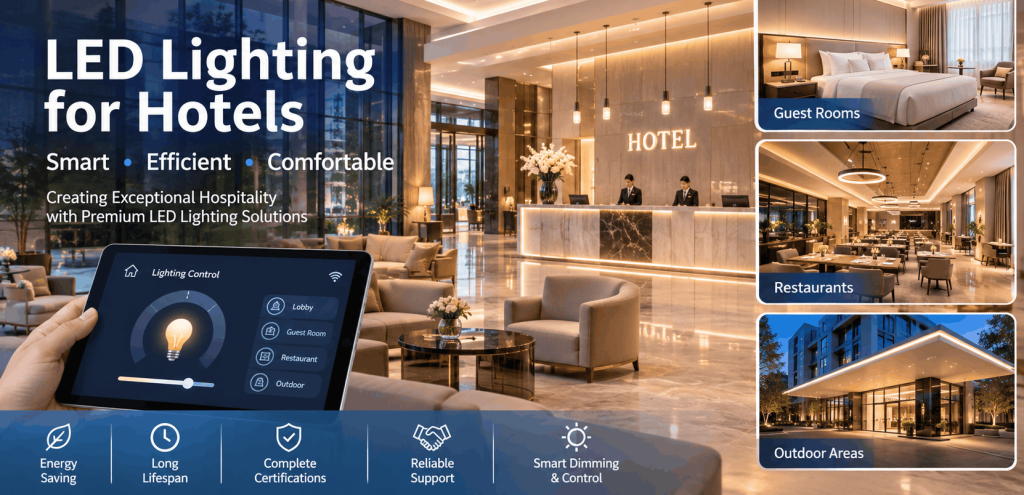
Why LED Lighting for Hotels Is Important
Hotels often operate for extended hours, and many public areas require lighting throughout the day and night. As a result, lighting efficiency, product reliability, and maintenance costs are important considerations for hotel operators.
A properly designed LED Lighting for Hotels solution can support both the visual and operational requirements of a hospitality property.
LED Lighting for Hotels Improves Energy Efficiency
Energy consumption is an important part of hotel operating costs. Lobbies, restaurants, corridors, reception areas, and outdoor spaces may require long periods of illumination.
LED lighting technology can help reduce electricity consumption compared with less efficient traditional lighting sources. In addition, suitable dimming and intelligent control functions can help hotels avoid unnecessary lighting output when full brightness is not required.
For example, a hotel may use different lighting schedules for daytime reception, evening dining, and overnight corridor operation. Guest rooms may also use adjustable brightness according to guest preferences.
The actual energy savings from LED Lighting for Hotels depend on the original lighting installation, product efficiency, operating hours, and control strategy. Buyers should compare the technical specifications of individual products instead of relying on general energy-saving percentages.
LED Lighting for Hotels Supports Long-Term Maintenance
Hotels need reliable lighting because maintenance activities can affect daily operations and guest experience. Replacing a light fixture in a high-ceiling lobby or decorative installation may require additional labor and equipment.
Selecting suitable LED Lighting for Hotels with reliable components and appropriate thermal management can help reduce replacement frequency.
When evaluating products, buyers should review the model-specific service-life information, driver specifications, operating environment, and warranty coverage. A long service-life claim should be supported by relevant product documentation rather than assumed from LED technology alone.
LED Lighting for Hotels Enhances Guest Experience
Lighting has a direct influence on how guests perceive a hotel. Warm and comfortable illumination can create a relaxing guest room, while carefully positioned accent lighting can highlight artwork, furniture, and architectural details.
Different hotel spaces require different lighting effects. Reception areas need practical visibility, restaurants may require a more intimate atmosphere, and guest rooms need flexible lighting for reading, resting, and working.
A professional LED Lighting for Hotels plan should balance visual comfort, functionality, and the hotel’s overall design concept.
LED Lighting for Hotels: Choosing Fixtures for Different Areas
A hotel contains many functional spaces, and each area has its own lighting requirements. Selecting suitable LED fixtures according to the application helps create a consistent lighting environment throughout the property.
LED Lighting for Hotel Lobbies and Reception Areas
The lobby is usually the first space guests see when entering a hotel. Its lighting should communicate the hotel’s brand positioning and create a welcoming atmosphere.
LED downlights, ceiling lights, spotlights, and decorative lighting can be combined to provide layered illumination. General lighting helps maintain visibility, while accent lighting highlights reception counters, artwork, architectural features, and decorative materials.
When selecting LED Lighting for Hotels for lobby applications, consider ceiling height, fixture placement, beam angle, glare control, color temperature, and interior surface finishes.
Reception desks also require sufficient task lighting so staff can complete check-in procedures comfortably. Lighting should avoid distracting reflections on computer screens and other glossy surfaces.
LED Lighting for Hotel Guest Rooms
Guest rooms are among the most important areas in hotel lighting design. Guests use these spaces for reading, working, resting, and preparing for the day.
A suitable LED Lighting for Hotels arrangement may include several fixture types:
- General lighting: Ceiling lights or downlights provide overall illumination.
- Bedside lighting: Reading lights offer convenient illumination for guests.
- Desk lighting: Task lighting supports working and studying.
- Bathroom lighting: Suitable fixtures provide practical visibility around mirrors and washbasins.
- Accent lighting: Indirect lighting creates a more comfortable room atmosphere.
Dimmable LED lighting is particularly useful in guest rooms because it allows guests to adjust brightness according to different activities.
However, buyers should confirm that the selected LED fixtures, drivers, dimmers, and control devices are compatible. Not every LED light supports every dimming method, so model-specific technical confirmation is necessary before procurement.
LED Lighting for Hotel Corridors and Staircases
Corridors and staircases need consistent illumination to support safe movement and clear visibility. These areas may operate for long periods, making energy efficiency and maintenance important factors.
LED downlights and ceiling fixtures can provide general lighting, while additional illumination may be needed near room entrances, elevators, signs, and staircase landings.
When purchasing LED Lighting for Hotels for corridors, consider installation height, light distribution, glare, maintenance access, and applicable building regulations. Emergency lighting requirements should be specified and verified separately according to local regulations and project design.
LED Lighting for Hotel Restaurants and Bars
Restaurants and bars require lighting that supports both functionality and atmosphere. A hotel restaurant may need different lighting scenes for breakfast, lunch, dinner, and private events.
LED downlights can provide general illumination, while spotlights can highlight tables, decorative features, and food displays. Other suitable lighting products may be used to create indirect or decorative effects.
Color rendering is an important consideration for restaurant LED Lighting for Hotels because it affects how food, furniture, and interior materials appear. Buyers should review the CRI specifications of the selected models and request samples when visual appearance is a priority.
If adjustable brightness is required, confirm that the fixtures and control components support the intended dimming function.
LED Lighting for Hotel Bathrooms and Spa Areas
Bathrooms and spa facilities require lighting that balances comfort, visibility, and environmental suitability.
Mirror and vanity lighting should provide practical illumination for grooming, while ceiling lights provide general visibility. Recessed LED downlights may be appropriate for certain ceiling designs, depending on the product specifications and installation environment.
For humid or moisture-exposed locations, buyers must check the applicable IP rating and electrical installation requirements. A fixture suitable for a dry guest room should not automatically be assumed suitable for a shower area.
Selecting appropriate LED Lighting for Hotels for bathrooms requires attention to product protection, installation position, and local electrical regulations.
LED Lighting for Hotel Outdoor and Landscape Areas
Outdoor lighting contributes to the appearance and functionality of hotel entrances, pathways, gardens, swimming pool surroundings, and building façades.
Depending on the design, LED wall lights, garden lights, floodlights, and other outdoor fixtures may be used to illuminate landscape features and improve visibility.
When selecting outdoor LED Lighting for Hotels, buyers should consider water protection, weather exposure, corrosion resistance, mounting methods, electrical safety, and maintenance access.
If the outdoor lighting system uses scheduled operation or centralized controls, compatibility between the fixtures and control devices should be confirmed before installation.
How to Select the Right LED Lighting for Hotels
Choosing suitable hotel lighting products requires coordination between the hotel owner, lighting designer, engineering contractor, and supplier. The following factors can help project buyers prepare a more reliable specification.
1. Select LED Lighting for Hotels According to Application
Different hotel spaces should not automatically use the same fixture type.
Downlights may be suitable for general ceiling illumination, spotlights can highlight decorative features, and LED strip lights can create indirect or architectural lighting effects.
Before purchasing LED Lighting for Hotels, prepare a lighting schedule that identifies each space, fixture category, installation method, quantity, and intended lighting function.
Buyers can explore the OKES product collection to review available lighting categories and identify products that may suit different hospitality applications.
2. Compare Brightness, Color Temperature, and CRI
The technical specifications of LED Lighting for Hotels should match the function of each space.
Important parameters include:
- Luminous flux: The total visible light output of a fixture, measured in lumens.
- Illuminance: The amount of light reaching a surface, measured in lux.
- Color temperature: The visual appearance of light, commonly described as warm, neutral, or cool white.
- Color Rendering Index (CRI): An indicator of how accurately colors appear under a light source.
- Beam angle: The distribution of light emitted by a fixture.
For example, guest rooms may prioritize comfortable ambient lighting, while reception desks and bathroom mirrors may require more focused illumination.
The final specifications should follow the lighting design and the technical documentation of the selected LED products.
3. Check Smart Dimming and Lighting Control Compatibility
Smart LED Lighting for Hotels can improve convenience and energy management when the system is properly designed.
Depending on the project requirements, lighting controls may support:
- Adjustable brightness for guest rooms.
- Preset lighting scenes for different activities.
- Scheduled lighting operation in public areas.
- Occupancy-based lighting control.
- Daylight-responsive adjustment.
- Centralized management of multiple lighting zones.
For example, a guest room may have separate lighting settings for reading, relaxing, and leaving the room. Public areas may use schedules or sensors to manage lighting according to operating requirements.
However, not every LED fixture supports every smart control function. Buyers should confirm compatibility between the fixture, driver, dimmer, sensor, controller, gateway, and software.
For projects that require integration with a building management system or hotel room management platform, discuss communication requirements with the system integrator before purchasing.
For additional information, see the OKES article on Smart LED Lighting for Commercial Projects.
4. Verify Certifications and Technical Documents
Hotel lighting products must meet the requirements applicable to their destination markets and intended applications.
Importers, wholesalers, and engineering contractors should request relevant certificates, test reports, product specifications, and compliance documents from the supplier.
When reviewing documents for LED Lighting for Hotels, check that the model numbers and document scope match the actual products being purchased. Different product categories and markets may have different requirements.
OKES presents its company background and certification information on the About OKES page. Buyers should still request the specific documents applicable to their selected models instead of assuming that every product carries identical certifications.
5. Evaluate Warranty and After-Sales Support
A hotel lighting project may involve a large number of fixtures. If products fail or technical issues occur after installation, delays can affect maintenance schedules and guest experience.
Before ordering LED Lighting for Hotels, confirm:
- Warranty period and coverage.
- Procedures for reporting product issues.
- Repair or replacement arrangements.
- Spare-part availability.
- Technical support for installation and troubleshooting.
- Responsibilities for shipping and related costs under warranty claims.
For smart lighting projects, it is also useful to clarify whether the supplier can assist with compatibility questions and technical documentation.
The OKES FAQ page provides general service information. Contact OKES to confirm the specific warranty and support conditions applicable to your order.
How to Choose a Reliable LED Lighting for Hotels Supplier
A reliable supplier contributes to more than product delivery. For hotel developers, lighting engineering companies, importers, wholesalers, and distributors, supplier selection can influence product quality, procurement efficiency, and long-term customer satisfaction.
Review Product Range and Manufacturing Experience
A supplier with multiple lighting categories can make it easier to coordinate products for guest rooms, public areas, restaurants, and outdoor spaces.
Buyers should review the company’s product range, manufacturing background, quality management processes, and international cooperation experience.
OKES states that it has been active in the lighting industry since 1993 and offers a range of lighting products and cooperation options, including OEM/ODM and agent cooperation. More company information is available through the official OKES website.
Request Samples Before Bulk Purchasing
For hotel projects, appearance and lighting performance are important. Product samples allow buyers and designers to evaluate brightness, color consistency, finish, glare, installation details, and overall suitability.
Before bulk purchasing LED Lighting for Hotels, confirm the approved model numbers and technical specifications. If dimming or smart control is required, test the complete combination of fixtures and control components wherever practical.
Compare Total Project Cost
The lowest unit price does not necessarily represent the best purchasing decision.
A more complete evaluation should include product cost, energy consumption, installation expenses, maintenance access, replacement frequency, warranty support, and delivery arrangements.
A product that better matches the hotel’s operating requirements may provide stronger long-term value even if its initial purchase price is higher.
Conclusion
LED Lighting for Hotels plays an important role in guest comfort, hotel appearance, energy management, and long-term maintenance. From lobbies and guest rooms to restaurants, corridors, bathrooms, and outdoor landscapes, every area needs an appropriate lighting arrangement.
When purchasing LED Lighting for Hotels, buyers should evaluate fixture selection, brightness, color temperature, CRI, energy efficiency, service-life information, smart dimming compatibility, applicable certifications, warranty coverage, and supplier support.
A successful hotel lighting project depends on both suitable products and reliable project coordination. OKES offers a broad lighting product range and has been active in the lighting industry since 1993.
Planning a hotel lighting project? Contact OKES to discuss your project requirements, request product information, and explore suitable LED Lighting for Hotels options for your next hospitality development.
FAQ About LED Lighting for Hotels
1. What type of LED Lighting for Hotels is best?
The best choice depends on the area and its function. Downlights and ceiling lights can provide general illumination, spotlights can highlight decorative features, and strip lights can create indirect lighting effects. Guest rooms, restaurants, corridors, and outdoor spaces may require different product combinations.
2. What color temperature is suitable for LED Lighting for Hotels?
Warm white is often used in guest rooms and relaxing hospitality areas, while neutral white may be suitable for workspaces and certain service areas. The final choice should follow the hotel’s design concept, visual requirements, and lighting plan.
3. Can LED Lighting for Hotels reduce electricity costs?
Yes. Efficient LED fixtures can reduce electricity consumption compared with less efficient traditional lighting. Dimming, occupancy sensing, and scheduling may provide additional savings when properly designed and used. Actual results depend on the products and operating conditions.
4. Is dimmable LED Lighting for Hotels suitable for guest rooms?
Yes. Dimmable lighting can give guests more control over brightness for reading, relaxing, and other activities. Buyers must confirm that the LED fixture, driver, dimmer, and control system are compatible.
5. What should buyers check when sourcing LED Lighting for Hotels?
Buyers should evaluate light output, color temperature, CRI, beam angle, energy efficiency, service-life data, installation requirements, certifications, warranty coverage, and after-sales support. Samples and model-specific technical documents are also useful before bulk purchasing.
6. Can LED Lighting for Hotels integrate with smart building systems?
Some LED lighting systems can integrate with smart room controls or building management platforms. Compatibility depends on the selected drivers, controllers, communication protocols, gateways, and software. Confirm the system requirements before ordering.
7. Does OKES provide LED Lighting for Hotels?
OKES offers multiple lighting product categories, including downlights, spotlights, ceiling lights, track lights, and strip lights. Buyers can contact OKES to discuss product selection, project requirements, OEM/ODM possibilities, and model-specific technical information.