
Choosing the right LED Lighting Manufacturer is an important decision for lighting contractors, project developers, importers, wholesalers, electrical distributors, and smart building integrators. The quality of a lighting supplier directly affects project costs, installation efficiency, customer satisfaction, and long-term business development.
Today’s B2B buyers expect more than competitive product prices. They need energy-efficient lighting, dependable product quality, suitable certifications, clear warranty policies, consistent supply, and lighting systems that can work with modern control technologies. A suitable manufacturing partner should understand these requirements and provide products and services that support different markets and applications.
OKES Lighting, established in 1993 in Guzhen, Zhongshan, China, provides lighting products and manufacturing services for global markets. Its product portfolio covers multiple lighting categories, while its business services include OEM and ODM cooperation for international customers.
This article explains how to evaluate an LED lighting manufacturer and identify a partner that can support your sourcing requirements, engineering projects, and long-term commercial objectives.
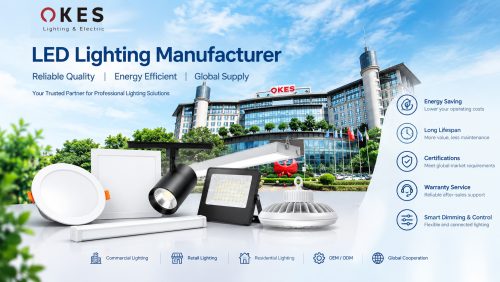
Why the Right LED Lighting Manufacturer Matters
For B2B customers, choosing a lighting supplier is a business decision rather than simply a product purchase. The manufacturer you select can influence procurement efficiency, product consistency, after-sales costs, and the competitiveness of your lighting business.
Reliable Product Quality for Long-Term Projects
Lighting contractors and distributors need products that perform consistently across different orders. Variations in brightness, color appearance, construction, or electrical performance can create installation problems and increase complaints after delivery.
A professional LED lighting manufacturer should have defined quality control procedures, appropriate testing equipment, and a system for managing production consistency. Buyers should also ask how incoming materials, finished products, and production batches are inspected.
For large projects, sample approval and written product specifications are particularly important. They help establish a clear reference before mass production and reduce the risk of receiving products that differ from the approved sample.
Stable Supply for Distributors and Importers
Importers, wholesalers, and lighting retailers often need repeat orders over an extended period. If a supplier cannot maintain product availability or communicate production schedules clearly, customers may face stock shortages and delayed projects.
When evaluating an LED lighting manufacturer, review its manufacturing facilities, product range, production planning, export experience, and ability to handle repeat orders. Ask how changes in specifications or packaging will be managed and whether the supplier can support your expected purchasing volume.
OKES describes its manufacturing operations, broad product portfolio, and international cooperation services on its official company website. These resources provide a useful starting point for B2B buyers assessing its manufacturing background.
Energy Efficiency: A Priority When Selecting an LED Lighting Manufacturer
Energy consumption is a major consideration in commercial buildings, retail environments, hotels, offices, and industrial facilities. For end users, efficient lighting can reduce electricity expenses over the operating life of a project. For contractors and distributors, it also creates a stronger value proposition when presenting products to customers.
Compare Lighting Efficiency, Not Just Wattage
Wattage indicates how much electrical power a lamp consumes, but it does not independently establish how effectively that power produces useful light.
When comparing products from different manufacturers, request verified information about luminous flux, luminous efficacy, color temperature, color rendering, beam angle, and other specifications relevant to the application.
The right comparison depends on the lighting task. A retail display may require controlled beams and accurate color rendering, while an office may prioritize comfortable, uniform illumination. Outdoor projects may require additional attention to environmental protection and optical distribution.
A reliable LED lighting manufacturer should help buyers understand these differences rather than recommend products based on wattage or price alone.
Evaluate Total Cost of Ownership
The lowest initial purchase price does not always result in the lowest long-term cost. Buyers should consider energy consumption, expected operating hours, maintenance requirements, replacement costs, and warranty conditions.
For example, a commercial building that operates lighting for extended periods may benefit significantly from efficient fixtures. However, the actual savings depend on the existing lighting system, electricity prices, usage patterns, and the performance of the proposed replacement products.
Before approving a project, compare realistic operating scenarios and use manufacturer-supplied specifications to estimate potential savings. This approach helps contractors and procurement teams explain the financial benefits to their customers.
Long Lifespan and Quality Control from an LED Lighting Manufacturer
Long service life is another major purchasing consideration, especially in locations where replacing fixtures involves labor costs, equipment rental, business interruption, or difficult access.
Understand What Affects LED Lighting Lifespan
The operating life of an LED lighting product depends on multiple factors, including component quality, thermal management, driver performance, ambient temperature, operating conditions, and product design.
Effective heat dissipation is particularly important because excessive temperatures can affect component reliability. The driver and other electrical components also influence the overall performance of the complete fixture.
When assessing an LED lighting manufacturer, ask what testing is conducted to evaluate product performance and reliability. Depending on the application, useful documentation may include thermal test results, electrical safety information, photometric data, and applicable lifetime assessments.
Do not rely solely on a general lifespan figure. Confirm the rated conditions and the exact product model to which the claim applies.
Check Manufacturing and Inspection Procedures
A structured quality management process helps reduce inconsistencies and improve accountability. Buyers can ask whether the manufacturer conducts incoming material inspections, in-process checks, final functional testing, and batch traceability.
For customized orders, it is also important to establish acceptance criteria before production begins. These may cover dimensions, finish, labeling, packaging, electrical characteristics, and other agreed specifications.
OKES outlines its manufacturing experience and quality-related capabilities on its About Us page. B2B buyers can use this information as a starting point and request additional documentation relevant to their specific product requirements.
Certifications and Compliance: What B2B Buyers Should Verify
Product compliance is essential when importing lighting products or supplying projects in regulated markets. Certification requirements vary according to the destination country, product category, electrical design, and intended application.
Confirm Certifications for the Exact Product
A manufacturer may have experience with multiple international certification systems, but this does not mean every product in its catalog carries the same approvals.
Before placing an order, identify the standards and documentation required in your target market. Depending on the product and destination, these may involve applicable electrical safety, electromagnetic compatibility, hazardous-substance, or energy-efficiency requirements.
Ask the LED lighting manufacturer for relevant certificates, test reports, issuing-body information, and model references. Verify that the documentation covers the exact product or product family being purchased and remains valid for the intended use.
OKES provides company-level information about its certification and quality management experience on its official website. Buyers should confirm the specific approvals available for each proposed product rather than assume that all models share identical certification coverage.
Prepare Documentation Before Shipment
For importers and engineering contractors, compliance checks should take place before mass production or shipment whenever possible.
Create a document checklist covering product specifications, labels, packaging requirements, test reports, certificates, and any market-specific declarations. If the project involves multiple fixture types, review each product separately.
Early verification reduces the risk of shipment delays, documentation gaps, and costly product substitutions. It also makes communication between manufacturers, importers, installers, and project owners more efficient.
Warranty and After-Sales Service from an LED Lighting Manufacturer
Warranty support can have a significant effect on the profitability of a distribution business and the maintenance budget of an engineering project. A clear warranty policy helps buyers understand their responsibilities and the support available if a product fails.
Review Warranty Terms Before Ordering
Do not compare manufacturers based on warranty duration alone. Review the actual terms, exclusions, claim procedures, and remedies.
Important questions include:
- What is the warranty period for the selected product?
- Does coverage apply to the complete fixture or only specified components?
- What evidence is required to submit a claim?
- Are repair, replacement, or spare-part solutions available?
- How are transportation costs and defective-product handling addressed?
- What support is available after the warranty period ends?
Warranty terms can differ between product categories and models. Obtain written confirmation for the items included in your quotation and purchase agreement.
Evaluate Technical Support and Spare Parts
For distributors and contractors, effective after-sales support goes beyond replacing defective products. It can also involve troubleshooting guidance, installation information, product training, and assistance identifying suitable replacement models.
Ask how the supplier handles technical questions, complaint investigations, and recurring product issues. For projects with many fixtures, maintaining product records and spare-part plans can simplify future maintenance.
OKES provides information about its service arrangements and after-sales support through its FAQ page. Buyers should discuss the specific response process and contractual terms with the sales team before confirming an order.
Smart Dimming and Connected Lighting Integration
Smart lighting is increasingly relevant to commercial buildings, hotels, retail spaces, offices, and projects designed around centralized control. Dimming and automation can improve flexibility, help manage energy use, and allow lighting behavior to respond to occupancy or operating schedules.
However, smart functionality depends on the compatibility of the fixture, driver, controller, communication protocol, and control system.
Choose the Right Dimming Method
Different applications may require different control methods. Depending on the product design, options can include phase-cut dimming, 0–10 V control, DALI, or wireless control solutions.
These technologies are not interchangeable. A fixture that supports one dimming method may not work correctly with another controller. Incompatible components can cause flickering, limited dimming ranges, unstable operation, or other performance issues.
Before selecting products, define the project’s control requirements. Ask the manufacturer to confirm the supported dimming method, compatible drivers, minimum dimming level where specified, and any relevant wiring or installation requirements.
Do not assume that every product from an LED lighting manufacturer supports every smart control protocol.
Plan for System-Level Compatibility
Weak-current contractors and smart building integrators should evaluate lighting as part of the complete building system. A successful installation requires compatibility between lighting fixtures, control devices, communication networks, and the intended automation platform.
For projects involving centralized control, confirm the system architecture early. Where appropriate, request technical documentation and conduct a compatibility test using the proposed fixture, driver, and controller before ordering at scale.
OKES offers a broad range of lighting categories, but the availability of particular dimming and connected-control functions must be confirmed for the selected models. Clear technical communication at the design stage helps avoid costly changes during installation.
Product Range and Customization from an LED Lighting Manufacturer
B2B buyers often source several types of lighting for one project or sales channel. Working with a manufacturer that offers multiple categories can simplify supplier coordination and create opportunities for more consistent purchasing and product planning.
Match Lighting Products to Different Applications
Different spaces require different lighting approaches. For example:
- Commercial interiors: Downlights, panel lights, spotlights, and track lights may be used in offices, shops, hotels, and public buildings.
- Retail and display areas: Adjustable track lighting and spotlights can help highlight merchandise and architectural details.
- Outdoor environments: Floodlights, garden lights, and other outdoor fixtures can support landscape and exterior applications, subject to the project’s environmental requirements.
- Residential projects: Ceiling lights, downlights, and other decorative or functional fixtures can serve different room layouts and design preferences.
Explore the available categories in the OKES product catalog to identify products relevant to your sourcing needs.
Consider OEM and ODM Cooperation
OEM and ODM services can help lighting brands, importers, and distributors develop products that suit their target markets. Depending on the agreed service scope, customization may involve product design, appearance, packaging, labeling, or selected technical specifications.
Before starting a customization project, prepare a clear brief covering the intended application, target market, required compliance, design preferences, estimated volume, packaging, and expected delivery schedule.
Ask the manufacturer to clarify tooling requirements, sample approval procedures, minimum order quantities, intellectual property arrangements, and production lead times. These details should be agreed upon before mass production.
OKES describes its OEM/ODM and cooperation services for global business customers. Contact its team to establish which customization options are available for your project.
Why Choose OKES as Your LED Lighting Manufacturer?
Selecting a manufacturing partner requires a balanced assessment of product coverage, production capabilities, quality management, commercial terms, and communication.
OKES Lighting has operated in the lighting industry since 1993 and is based in Guzhen, Zhongshan, China. According to its official website, the company serves international markets with a broad lighting portfolio and provides OEM/ODM services for business customers.
For B2B buyers, relevant areas to evaluate include:
- Broad product selection: Multiple lighting categories can support different residential, commercial, and engineering requirements.
- Manufacturing experience: An established presence in the lighting industry provides a foundation for discussing product development and sourcing needs.
- Customization support: OEM/ODM cooperation can help businesses explore product and branding requirements.
- Quality and compliance documentation: Buyers can discuss the documentation applicable to their chosen models and destination markets.
- Business cooperation services: International buyers can communicate with OKES about product selection, quotations, and potential distribution or project cooperation.
The best way to assess suitability is to match these capabilities against your own specifications. Request product details, relevant certificates, samples where appropriate, and written commercial terms before making a purchasing decision.
Conclusion: Find the Right LED Lighting Manufacturer for Your Business
Choosing an LED lighting manufacturer requires more than comparing quotations. Energy efficiency, product lifespan, quality control, certification coverage, warranty conditions, smart control compatibility, and supply reliability all influence the long-term value of a lighting purchase.
For lighting contractors, importers, wholesalers, electrical distributors, and smart building integrators, a clear sourcing process helps reduce project risks and improve customer satisfaction. Define your technical requirements first, verify documentation for the exact products, and establish written expectations for quality, delivery, and after-sales service.
With its long-standing lighting industry experience, diverse product portfolio, and OEM/ODM cooperation services, OKES offers a starting point for businesses exploring lighting supply and manufacturing partnerships.
Ready to source LED lighting for your next project or distribution business? Contact OKES to discuss your target applications, product specifications, compliance requirements, customization needs, and purchasing plans. The team can help you identify suitable products and clarify the next steps toward a potential long-term partnership.
Visit the OKES website or use the Contact Us page to start your inquiry.
FAQ: LED Lighting Manufacturer
1. How do I choose a reliable LED lighting manufacturer?
Evaluate manufacturing experience, product quality, relevant certifications, production consistency, warranty terms, technical support, and supply capacity. Request product documentation and samples where appropriate, and confirm important requirements in writing before ordering.
2. What should B2B buyers check when purchasing LED lighting?
Buyers should review luminous output, energy efficiency, color temperature, color rendering, product construction, applicable compliance documents, warranty conditions, packaging, and delivery arrangements. The precise checklist depends on the application and destination market.
3. How can LED lighting help reduce operating costs?
Efficient LED products can reduce electricity consumption compared with less efficient lighting alternatives. Actual savings depend on the existing system, product performance, operating hours, electricity rates, and maintenance requirements.
4. Does every LED lighting product support smart dimming?
No. Dimming capabilities depend on the fixture, driver, control method, and system compatibility. Buyers should confirm supported protocols and test the proposed components before committing to a large order.
5. How can I verify lighting certifications?
Request current certificates and relevant test reports, check the covered product models, and confirm that the documentation meets the requirements of the intended market. Do not assume that every product from the same manufacturer has identical approvals.
6. Does OKES provide OEM and ODM lighting services?
OKES states that it supports OEM/ODM cooperation for global business customers. Contact the company to confirm available customization options, minimum order requirements, samples, lead times, and technical specifications for your project.
7. How can I request a quotation from OKES?
Visit the official OKES website and contact its sales team. To receive a more relevant quotation, provide your target product categories, quantities, destination market, required certifications, customization preferences, and expected delivery schedule.