
LED Lighting Quality Inspection is an important step for lighting contractors, importers, wholesalers, distributors, and smart building integrators who need consistent product performance and dependable supply. Before purchasing LED lighting in bulk, buyers should verify product specifications, inspect samples, review compliance documents, and establish clear quality acceptance criteria. A structured LED Lighting Quality Inspection process can help reduce procurement risks, prevent avoidable defects, and improve long-term customer satisfaction.
LED lighting products may look similar in a catalogue, but their performance can vary according to component quality, driver design, thermal management, assembly processes, and manufacturing controls. Without appropriate LED Lighting Quality Inspection, buyers may discover specification mismatches, inconsistent light output, damaged products, or missing documentation after delivery.
For commercial and architectural lighting projects, product quality affects not only illumination but also installation schedules, maintenance costs, warranty claims, and the reputation of the supplier. This guide explains how to conduct LED Lighting Quality Inspection before ordering, during sample approval, and before shipment, helping buyers make more informed decisions when sourcing lighting products.
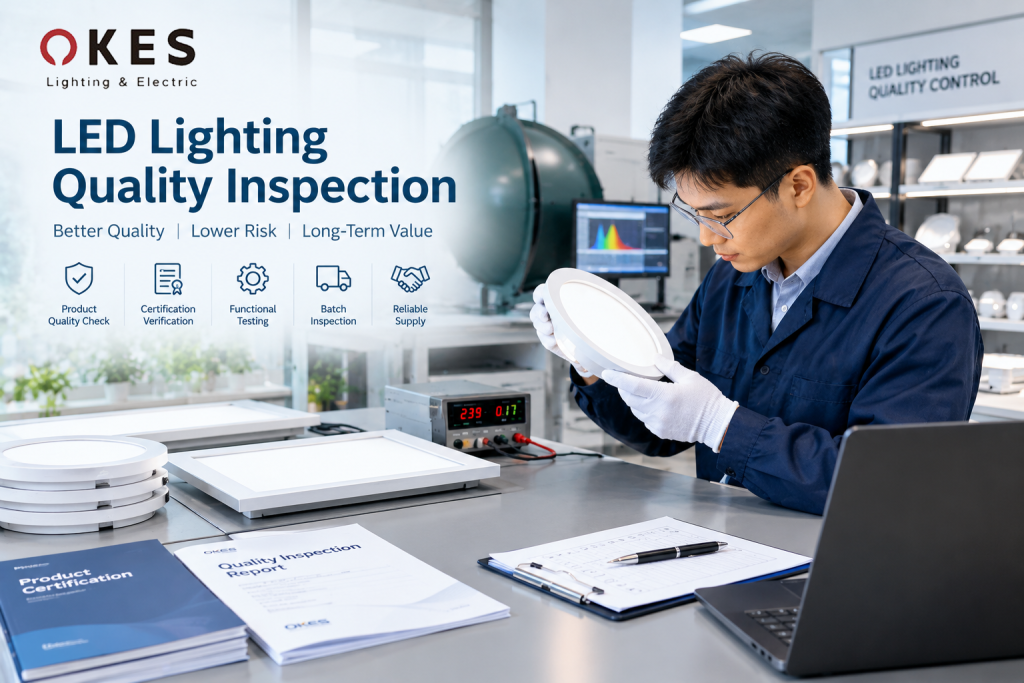
Why LED Lighting Quality Inspection Matters
LED Lighting Quality Inspection helps buyers determine whether products meet agreed specifications and are suitable for their intended applications. It combines document review, visual checks, functional testing, and batch acceptance procedures according to the product type and project requirements.
For lighting engineering companies and contractors, effective LED Lighting Quality Inspection can reduce the risk of installation delays and costly replacements. For importers and wholesalers, it helps maintain consistent inventory quality and reduce customer complaints. For lighting distributors and system integrators, it supports more reliable product recommendations and after-sales service.
A practical inspection process can help buyers:
- Identify visible defects before products reach the installation site.
- Confirm that delivered products match approved samples and purchase specifications.
- Verify applicable certifications and compliance documents.
- Check electrical function and relevant lighting performance.
- Reduce inconsistencies between units in a bulk order.
- Establish clearer procedures for handling defective products.
- Support warranty claims with documented inspection records.
LED Lighting Quality Inspection cannot guarantee that every product will remain failure-free throughout its service life. Instead, it provides a systematic way to identify potential problems, document acceptance requirements, and manage product quality risks before they affect a project.
LED Lighting Quality Inspection Before Purchasing
1. Review LED Lighting Specifications
The first stage of LED Lighting Quality Inspection is a detailed review of the product specification. Buyers should identify the exact model and confirm that its documented performance matches the requirements of the intended application.
Depending on the product, relevant specifications may include rated power, luminous output, luminous efficacy, color temperature, color-rendering performance, beam angle, input voltage, dimensions, mounting method, and housing materials.
For outdoor fixtures, buyers may also need to check the applicable ingress protection rating and suitability for the installation environment. For indoor commercial lighting, glare control, light distribution, and color consistency may be more important.
If a project requires smart dimming, the specification should identify the supported dimming method and any necessary control equipment. A product described as dimmable should not automatically be assumed to work with every dimmer, driver, or building automation system.
During LED Lighting Quality Inspection, compare the technical documentation with the quotation and purchase order. Avoid relying solely on general descriptions such as “high efficiency,” “long lifespan,” or “premium quality.” Request specific, model-level information wherever possible.
Buyers can explore the OKES product collection to identify relevant lighting categories and then request detailed specifications for the models under consideration.
2. Evaluate the Manufacturer’s Quality Information
Reliable LED Lighting Quality Inspection begins before samples arrive. Buyers should understand what quality information the manufacturer can provide and how product requirements are controlled during production.
Useful information may include technical datasheets, applicable test reports, product labels, inspection procedures, and documentation explaining how nonconforming products are handled. For large orders, buyers may also ask how the supplier maintains consistency between approved samples and production batches.
OKES describes its company background, manufacturing experience, and quality-related information on the About OKES page. Buyers should use these details as a starting point and confirm the documents and quality controls applicable to their selected products.
A manufacturer’s general capabilities do not automatically establish the performance of every individual model. Product-specific evidence remains important when making purchasing decisions.
3. Verify Certifications and Compliance Documents
Certification verification is a key part of LED Lighting Quality Inspection for importers and distributors. The applicable requirements depend on the destination market, product category, electrical design, and intended use.
Before ordering, identify which certificates, declarations, labels, and test reports are required. Ask the supplier to provide documents that correspond to the exact model being purchased.
Check the product identification, document scope, issuing organization, validity where applicable, and relevance to the destination market. If necessary, verify the documents with the relevant issuing body or official database.
Do not assume that a certificate covering one product automatically applies to every product in a manufacturer’s range. Similarly, a company-level management certificate should not be treated as a substitute for product-specific compliance documentation.
Completing this stage of LED Lighting Quality Inspection before production or shipment can help prevent documentation gaps, customs complications, and unnecessary project delays.
LED Lighting Quality Inspection During Sample Approval
1. Check Appearance and Construction
Sample approval allows buyers to evaluate the actual product before committing to a bulk purchase. During LED Lighting Quality Inspection, exam